If you have searched for a way to get an operator qualified without pulling a crew off the floor, you have probably seen online course listings promising fast forklift tickets and mobile equipment credentials. It is a fair question to ask, and a lot of Victoria employers and individual operators ask it every week. The honest answer is that part of the process can happen online, but the part that actually proves someone can run the machine cannot. Real Mobile Equipment Certification Victoria involves a hands-on practical evaluation on the equipment, and no web portal can replace watching an operator work under load in real conditions.
This guide walks through what an online theory portion genuinely covers, where it stops, why the practical piece decides whether an operator is truly job-ready, and what a legitimate blended or in-person path looks like on Vancouver Island. If you want to skip ahead and talk to a trainer, you can review the mobile equipment certification in Victoria page any time.
The Short Answer Employers Are Actually Looking For
Here is the direct response to the search that brought most people here. You cannot become a fully qualified forklift or mobile equipment operator through an online course alone. What you can do online is complete a theory component, sometimes called the knowledge portion, which teaches the classroom side of operating a machine. That theory has value, but on its own it does not make someone competent to operate, and it will not satisfy a serious employer or a workplace inspection. The classroom half tells you what a load chart is. It does not prove you can read one while a fork is loaded three metres in the air on an uneven yard in Saanich. Those are two different things, and the gap between them is exactly where injuries and failed evaluations happen.
This distinction matters because a certificate that only reflects an online quiz can create a false sense of readiness. An employer who accepts an online-only document may believe an operator is trained when the operator has never been observed running the equipment. That is a genuine liability, and it is the main reason reputable training on Vancouver Island keeps the practical evaluation in the process. The rest of this article explains why that is the case and how to make sure the training you buy actually holds up.
What Online Forklift and Mobile Equipment Courses Actually Offer
Online courses are not a scam by default. Many of them deliver a genuinely useful theory component, and the better ones are built around the same knowledge an operator should carry into the yard. The problem is not that they exist. The problem is when the online piece is sold as the whole thing rather than as one part of a larger process. Understanding what the online portion does well helps you use it correctly instead of relying on it for something it was never designed to do.
A solid online theory module typically walks a learner through the fundamentals before they ever touch a machine. That grounding is real, and it can shorten the classroom time needed in person. A good knowledge portion usually explains equipment components and controls, and how different mobile machines are designed to behave under load. It teaches the principles of stability, including the stability triangle and how a counterbalance forklift keeps its footing when a load is raised. It covers load handling basics such as reading a data plate, understanding rated capacity, and the center of a load, all of which decide whether a lift is within limits or heading for trouble.
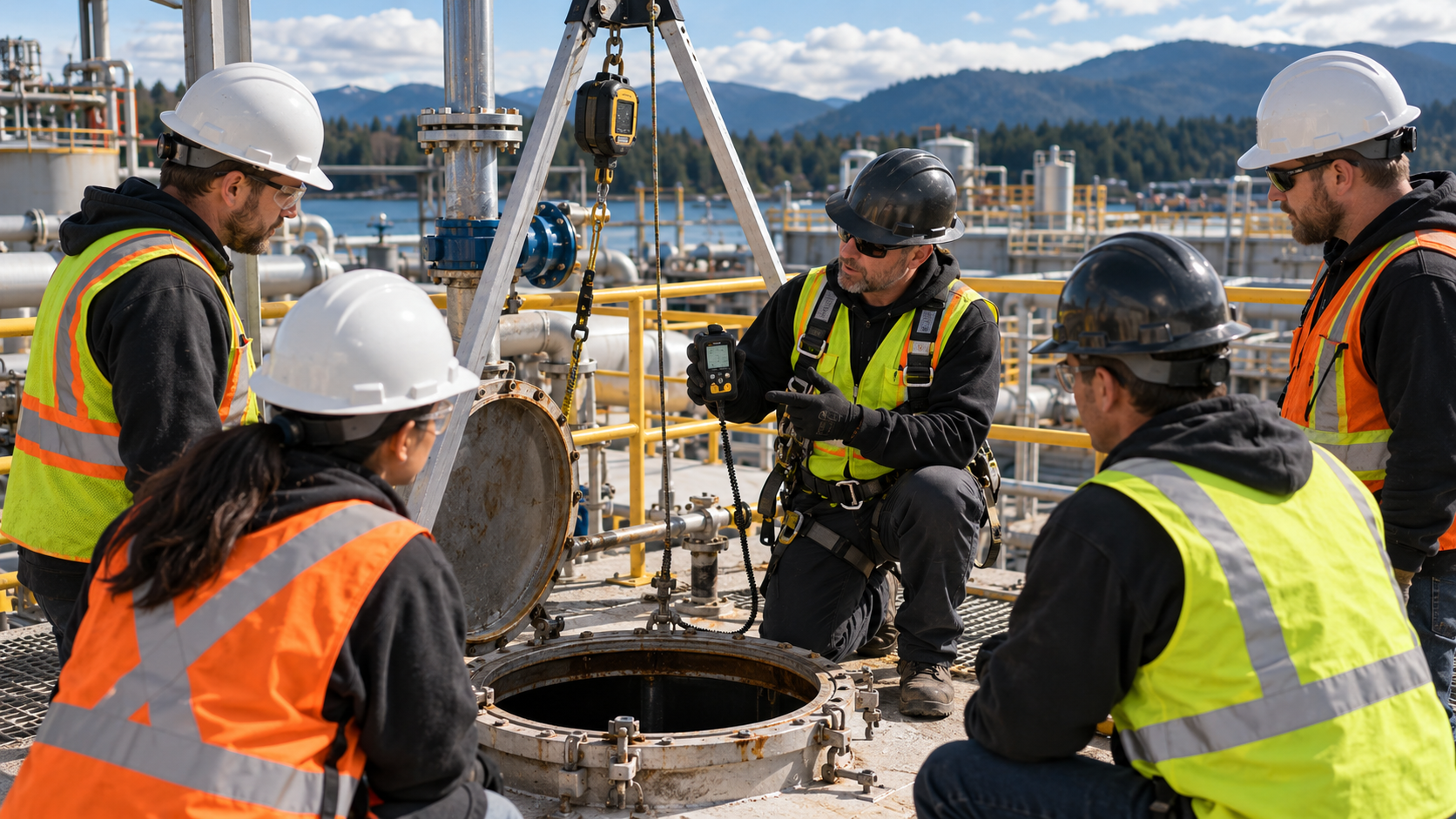
Beyond the mechanics, a strong theory component builds hazard awareness for pedestrians, blind corners, ramps, docks, and the shared traffic areas that cause so many yard incidents. It walks a learner through pre-use inspection theory and why a walkaround matters before every shift, and it sets out general operator responsibilities, including the expectation under WorkSafeBC that operators be trained and competent before they run equipment. Taken together, that is a genuinely useful foundation, and there is no reason to dismiss it.
All of that is worthwhile. A learner who finishes a good theory module walks into the practical portion already understanding the vocabulary and the logic of careful operation. That is a head start, not a finish line. The knowledge portion answers the question of what to do. It cannot answer the question of whether this particular person can actually do it on this particular machine, and that second question is the one that decides real competency.
Why a Hands-On Practical Evaluation Cannot Be Skipped
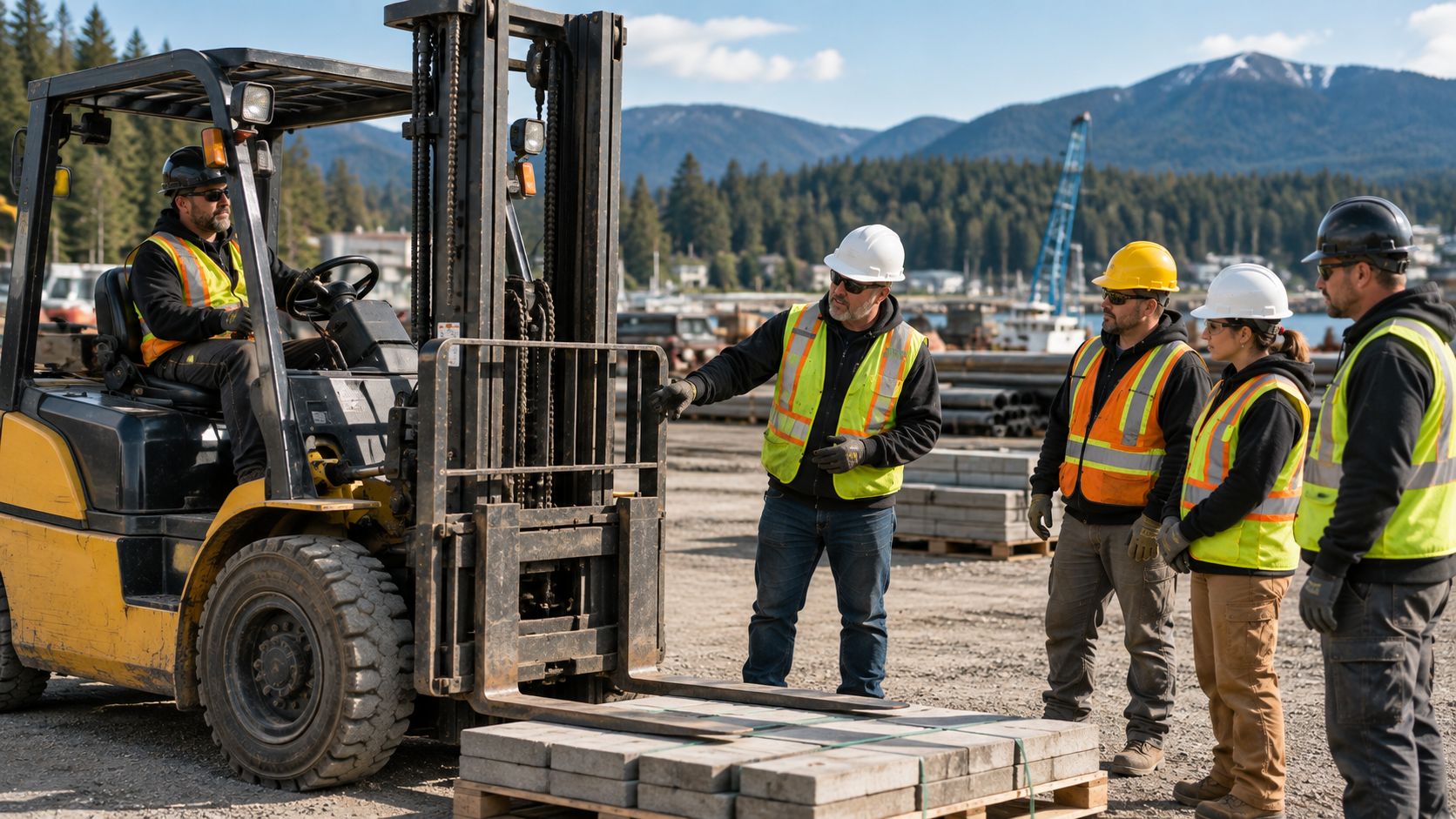
The practical evaluation is where training stops being theory and starts being proof. An evaluator watches the operator complete a pre-use inspection, mount the equipment, and perform real tasks such as lifting, traveling, stacking, and maneuvering in tight space. This is not a formality. It is the only reliable way to confirm that the person in the seat can translate classroom knowledge into controlled, predictable movement around people and product. You simply cannot verify that through a screen.
Consider how much of operating a machine is physical judgment that no quiz can measure. An operator has to feel how a loaded mast changes the balance of the machine. They have to judge speed on a grade, sense when a load is shifting, and react to a pedestrian stepping out from behind a rack. They have to know how their specific machine responds when they feather the controls. These are learned through repetition under the eye of someone qualified to correct mistakes before they become habits. A theory portal has no way to see any of it.
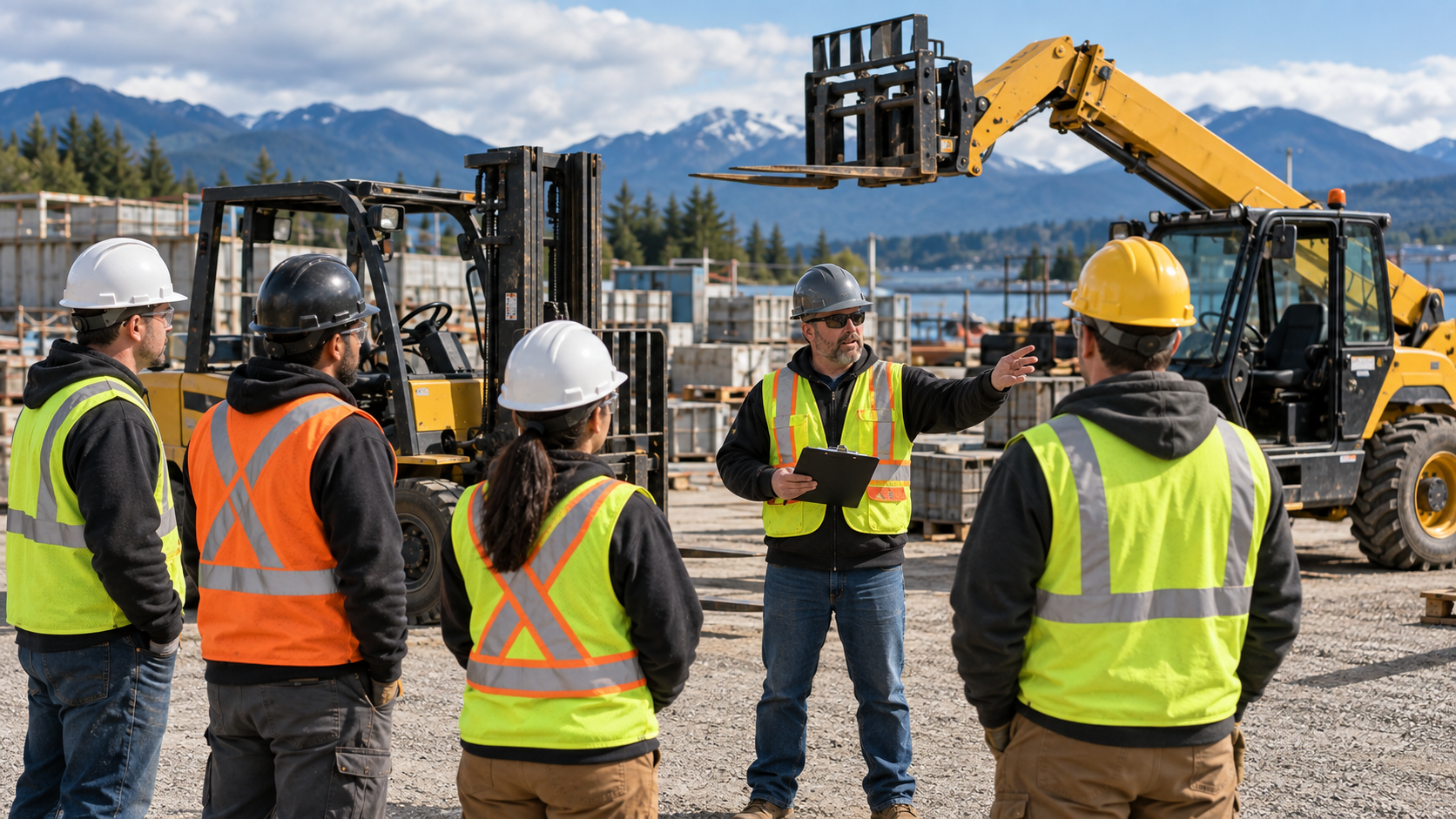
There is also the matter of familiarization, which is often confused with the general practical evaluation but is a distinct and important step. Even a seasoned operator moving to a different make or model, or a different attachment, needs time to learn how that specific unit behaves. A reach truck does not handle like a counterbalance forklift. A telehandler does not steer like a warehouse machine. A rough terrain forklift on a Colwood construction site behaves nothing like a smooth-floor unit in a distribution warehouse. The practical portion is where that machine-specific and site-specific reality gets addressed, and it is impossible to deliver remotely.
Finally, the practical evaluation protects the employer as much as the operator. When something goes wrong, one of the first questions asked is whether the operator was properly trained and evaluated on the equipment they were using. A documented hands-on assessment, performed by a qualified evaluator, is far stronger evidence of due diligence than a printout from an online quiz. That is not a technicality. It is the difference between a defensible training record and a document that falls apart the moment anyone examines it.
The Problem With Online-Only Certificates
The internet is full of sites that will sell a forklift certificate for a small fee after a short multiple choice test. They are attractive because they are fast and cheap, and they arrive as a printable card that looks official. The trouble is what that card actually represents, which is often nothing more than a passed quiz. It does not represent an observed, competent operator, and most Victoria employers who understand their responsibilities will not accept it as sufficient.
The risks of relying on an online-only document fall into a few clear categories, and it helps to see them side by side against what a proper process delivers.
| Consideration | Online-Only Certificate | Blended or In-Person Training With Evaluation |
| Proof of ability | Confirms a passed quiz only, no observed operation | Confirms an evaluator watched the operator run the machine |
| Equipment and site relevance | Generic content, not tied to your machines or yard | Familiarization on the actual equipment and conditions used |
| Employer acceptance | Often rejected as incomplete or inadequate | Widely recognized as legitimate operator training |
| Due diligence record | Weak, hard to defend after an incident | Documented practical assessment that supports due diligence |
| Real competency | Untested in physical, real-world conditions | Demonstrated under load in realistic tasks |
There is a second, quieter problem with online-only certificates. They can lull both the operator and the employer into thinking a box has been ticked when the underlying risk has not changed at all. An operator who has never been coached on the yard may carry bad habits that a screen could never catch. A supervisor who files the certificate may assume the person is ready and assign them to a busy dock. If an incident follows, the paper trail actually works against the business, because it shows a shortcut was taken where a real evaluation belonged. Fast and cheap can become slow and expensive very quickly.
None of this means the online world has no place. It means the certificate has to reflect real training, not replace it. When the theory portion feeds into a genuine practical evaluation, the same efficiency that makes online attractive becomes a real advantage rather than a hidden liability.
What a Legitimate Blended or In-Person Path Looks Like
A blended path takes the strengths of online learning and combines them with the part that has to happen in person. In practice this usually means the operator completes the theory component first, at their own pace, and then meets a qualified trainer for the hands-on portion and the practical evaluation. Done well, this can shorten the time a crew spends off the floor while still delivering a complete and defensible result. The key word is complete. The online part shortens the classroom, it does not remove the yard.
A straightforward in-person path is equally valid and is often the better fit for a full crew or a workplace that wants everyone trained together on the same equipment. In that model the theory and the practical happen on the same visit, frequently at the employer’s own site, so operators learn on the machines and in the conditions they will actually work with. For many Victoria operations, onsite delivery is the most efficient option because it removes travel and lets the trainer address the real hazards of that specific yard.
Whichever route you choose, a legitimate process shares the same backbone. Understanding that backbone lets you evaluate any provider quickly, whether they call their offering blended, online-assisted, or fully in-person. Ask how each of these elements is handled before you commit.
- A real theory component, whether online or in the classroom, that covers the knowledge an operator needs.
- A hands-on portion on the actual class of equipment the operator will run.
- A documented practical evaluation performed by a qualified evaluator who watches the operator work.
- Machine and site familiarization so the operator knows the specific unit and the conditions.
- A clear, verifiable training record the employer can keep and produce if asked.
- A trainer who can explain how their process aligns with WorkSafeBC expectations for trained and competent operators.
If a provider cannot describe how the practical evaluation happens, or if they suggest the whole thing can be finished online without anyone observing the operator, that is your signal to look elsewhere. A credible trainer will always keep the hands-on assessment in the process, because that is the part that makes the qualification mean something.
How Mobile Equipment Certification in Victoria Is Done Properly
Victoria and the wider Vancouver Island market run a broad mix of equipment across warehousing, construction, marine, forestry support, and municipal work. That variety is exactly why a one-size printout does not serve local employers well. A qualification done properly here starts by matching the training to the machine and the workplace, not by handing someone a generic card. Counterbalance forklifts, reach trucks, telehandlers, and other mobile units each carry their own handling characteristics, and proper training respects those differences instead of pretending they do not exist.
A proper local process also respects the reality of running a business. Employers cannot shut down a yard for a week, so the good options are built around minimizing disruption. Onsite delivery lets a trainer come to your Victoria facility and qualify operators on your own equipment, in your own traffic patterns, which is both more efficient and more relevant than sending people away to learn on a machine they will never see again. When a theory portion can be completed ahead of time, the in-person day gets shorter without cutting the parts that matter.
Duration varies, and any honest provider will tell you that. A focused course for a small group can often be completed in a single day, while a larger crew, multiple equipment types, or a mix of new and experienced operators can extend the schedule. What should never vary is the presence of the practical evaluation. The timeline flexes around your operation. The hands-on assessment stays fixed, because removing it would remove the whole point.
It is also worth remembering that qualification is not a one-time event that lasts forever. Operators move to new equipment, sites change, time passes, and refreshers keep skills current. A proper local provider will help you plan for that instead of treating the first ticket as the end of the story. Building a simple internal habit of tracking who was trained on what, and when, saves a scramble later and keeps a crew genuinely ready rather than just documented.
How to Choose a Provider You Can Trust
Because the online space is crowded with quick-certificate sellers, it helps to have a short mental checklist when you are comparing options for operators in the Victoria area. The goal is to separate real training from a paper transaction. A few plain questions will usually reveal which one you are dealing with, long before you spend a dollar.
Ask whether an evaluator personally observes each operator running the equipment, and how that observation is documented. Ask whether the training can be delivered on your own machines and at your own site. Ask how they handle different equipment classes, since a provider who treats every machine the same is a provider who does not understand the work. Ask how their approach lines up with WorkSafeBC expectations for trained and competent operators, and listen for a careful, specific answer rather than a vague promise. Finally, ask about the instructor’s own background, because real operating experience behind the training tends to show up in how well operators are coached.
A provider who answers those questions clearly, and who keeps the hands-on evaluation at the center of the process, is offering something an online-only certificate cannot. That is the standard worth holding out for, and it is the standard a good Vancouver Island trainer will meet without hesitation.
How VIF Safety Training Delivers Real Competency
VIF Safety Training is built around the part of the process that actually proves competency, which is the hands-on work. The company is led by Darrell Block, an IVES certified trainer with 24 years of experience driving mobile equipment, so the coaching operators receive comes from someone who has spent a career in the seat, not just in front of a classroom. That experience shapes how operators are evaluated and corrected, and it is the kind of judgment no online portal can offer.
For Victoria employers, VIF Safety Training focuses on practical, real-world delivery. Training can be arranged on the equipment operators actually use, with attention to the specific hazards and conditions of the workplace, so operators finish genuinely ready rather than simply holding a card. The approach keeps the theory efficient and the practical evaluation front and center, which is exactly the balance a legitimate blended or in-person path requires. The result is a training record an employer can stand behind and operators who can do the job with confidence.
If you are deciding how to qualify operators and want a path that holds up in the real world, talk to a trainer before you commit to any online-only option. VIF Safety Training can walk you through blended and in-person choices, arrange training on your own equipment, and make sure the practical evaluation is handled properly. Call (250) 889-2074 or email info@vanisleforklift.ca to book or ask about training in Victoria, and you can also contact VIF Safety Training to plan a session around your schedule.
Frequently Asked Questions
- Can you get fully forklift certified online in Victoria?
No, you cannot complete the entire process online. An online theory portion can teach the knowledge component, but a qualified operator must also pass a hands-on practical evaluation on the equipment. Only that in-person assessment proves real competency and stands up to employer and workplace scrutiny.
- Is an online-only forklift certificate accepted by employers?
Most employers who understand their responsibilities will not accept an online-only certificate as complete training. It usually reflects a passed quiz rather than an observed, competent operator. A document that includes a documented practical evaluation is far stronger and much easier to defend after any incident.
- What is the difference between the theory portion and the practical evaluation?
The theory portion covers knowledge such as stability, load charts, inspections, and hazard awareness, and it can be delivered online or in a classroom. The practical evaluation is where a qualified evaluator watches the operator actually run the machine. Both are needed, but only the practical portion confirms the person can do the job.
- Does a blended course save time for a busy crew?
Yes, a blended path can reduce time off the floor because operators complete the theory component ahead of the in-person day. This shortens the classroom time without removing the hands-on evaluation. The practical assessment still happens in person, since that is the part that cannot be replaced.
- Do experienced operators still need a hands-on evaluation?
Yes, experience does not remove the need for evaluation, especially when moving to a different make, model, or attachment. Each machine handles differently, and familiarization on the specific unit matters. A practical assessment confirms an experienced operator can safely run the equipment and conditions in front of them.
- Can VIF Safety Training deliver mobile equipment training at our Victoria site?
Yes, training can often be arranged onsite so operators learn on your own machines and in your own conditions. Onsite delivery reduces travel and disruption while keeping the training relevant to your workplace. Contact VIF Safety Training at (250) 889-2074 or info@vanisleforklift.ca to plan a session.
- How long does mobile equipment training usually take?
Duration varies by course, equipment type, and the number and experience of operators. A focused course for a small group can often be completed in a single day, while larger crews or multiple machine types may take longer. What stays constant is the hands-on practical evaluation.
- Does an operator qualification last forever once completed?
No, qualification is not a permanent, one-time event. Operators may need refreshers when they change equipment, when sites change, or as time passes, and WorkSafeBC expectations around trained and competent operators continue to apply. A good provider helps you plan for keeping a crew current rather than treating the first ticket as the end.