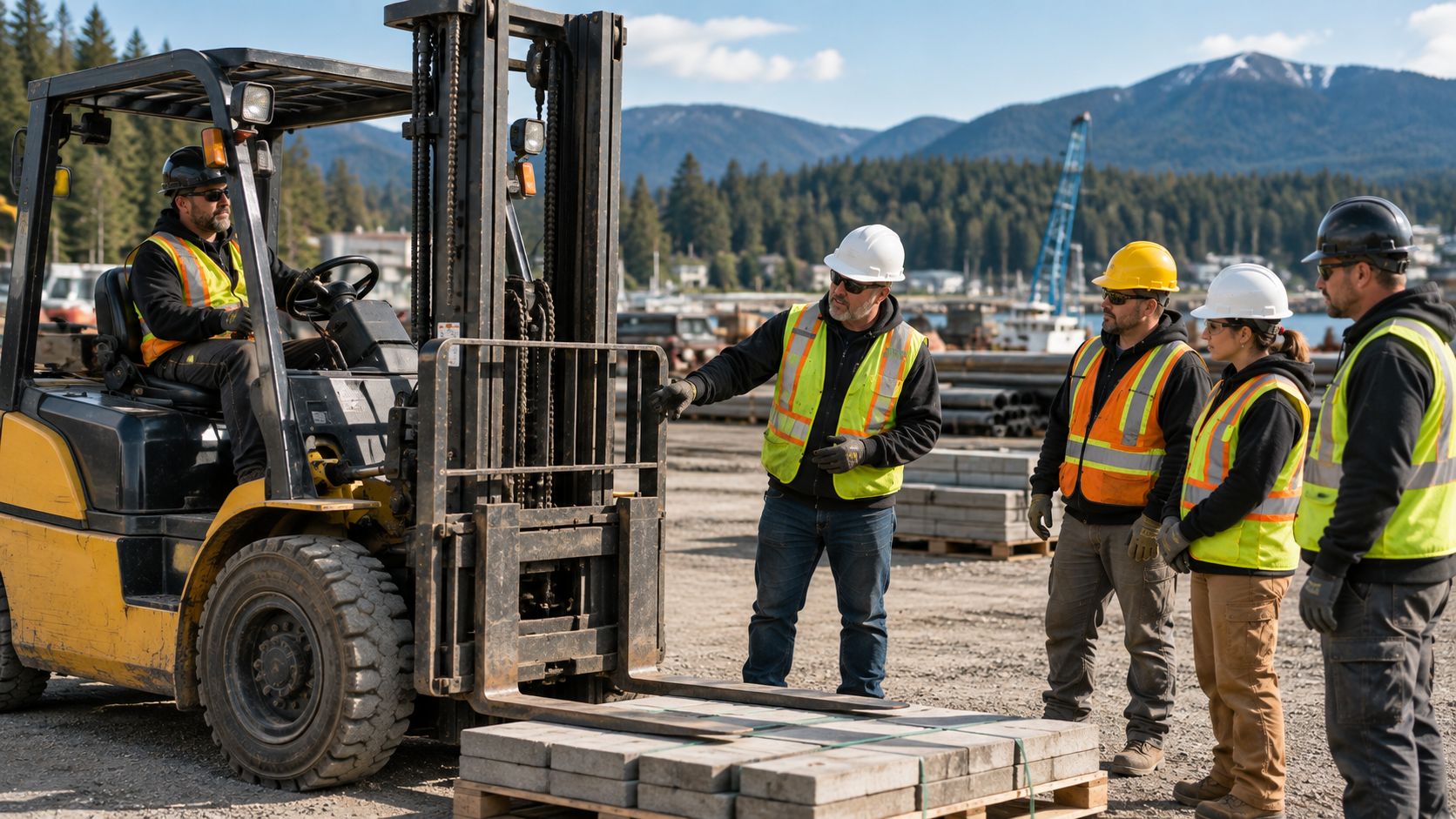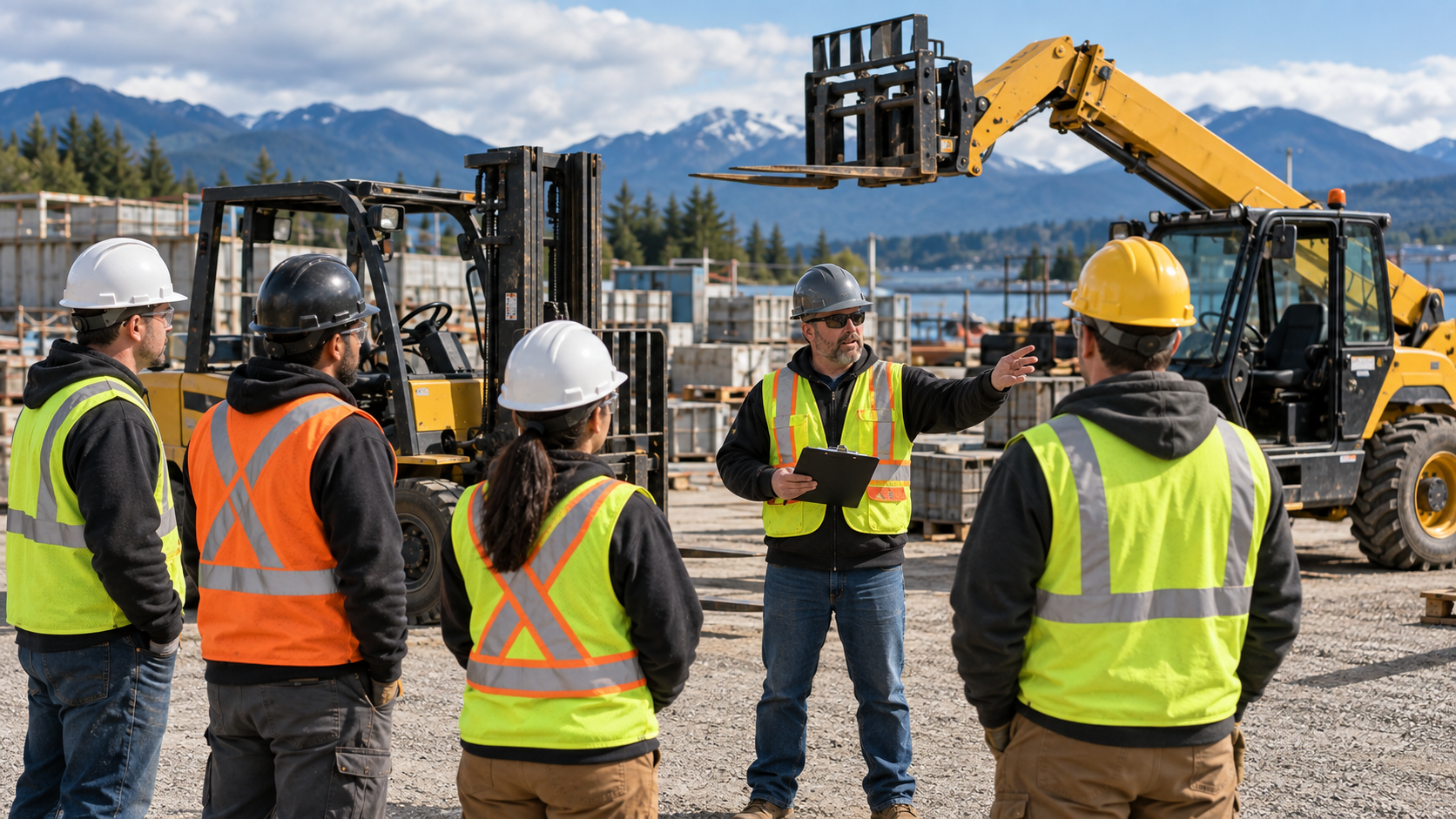
Quick answer: Telehandler training in Campbell River covers classroom theory, load chart reading, stability and terrain awareness, pre-use inspection, attachment handling, and a hands-on evaluation that proves an operator can run the machine. It follows WorkSafeBC’s mobile equipment expectations and the CSA B335 standard for lift trucks. Any worker who operates a telehandler needs it, from brand new hires to experienced operators who are new to this specific machine.
Telehandlers show up on Campbell River construction sites, rural yards, materials suppliers, and mill properties because one machine can reach out, lift high, and swap attachments to handle jobs a standard forklift never could. That flexibility is also why the training behind the machine matters so much, and why employers keep asking two practical questions before they book a course. What does the training actually cover, and which people on the crew genuinely need it. This guide answers both in plain terms, so you can plan Telehandler Operator Training Campbell River around your operation instead of guessing. If you already know a course is on your list, you can review VIF Safety Training’s telehandler operator training in Campbell River and build a plan from there.
The short answer is that proper telehandler training is far more than a slideshow and a certificate. It gives an operator the theory to understand why the machine behaves the way it does, the practical time to build real handling skill, and an observed evaluation that confirms they can do the work rather than assuming it. On the question of who needs it, the honest rule is simple. If a person operates the telehandler, that person needs training on the telehandler, and a ticket for a different machine does not fill the gap.
What Telehandler Certification Actually Means in British Columbia
In British Columbia there is no single government telehandler license you collect at a counter. What employers and operators are actually working toward is documented training paired with demonstrated competency on the machine, and that expectation comes from WorkSafeBC. The province’s Occupational Health and Safety Regulation addresses mobile equipment in Part 16, and the general principle is straightforward even without quoting a specific clause. A worker should not operate mobile equipment unless they have been trained in its use and can show they are competent to run it, and the employer carries the responsibility for making sure that is true.
Quality telehandler training in Campbell River is built to align with CSA B335, the recognized Canadian safety standard for lift trucks, which sets out the instruction and operator evaluation that underpin real competency. When a provider says their program follows that standard, it should mean the operator is taught the theory, assessed on the actual equipment, and signed off by a qualified evaluator. The word certification, in this context, describes that whole package of training plus a documented, observed assessment, not a piece of paper handed out at the end of a video.
This distinction matters because an incident review does not ask whether someone attended a course. It asks how the operator was deemed competent on that specific machine, and whether a record backs it up. For exact requalification intervals and any updated requirements, an employer should confirm the current standard directly with WorkSafeBC rather than relying on a number heard secondhand, because the point of training is to hold up under real scrutiny, not just to check a box.
What Telehandler Operator Training in Campbell River Covers
A thorough telehandler course moves through four connected stages, each building on the last, so an operator finishes with both understanding and proven skill. Skipping any one stage leaves a gap that shows up later on the job, usually at the worst possible moment. The sections below break down what each part of the training should include and why it belongs in the program.
Classroom theory and load charts
The classroom portion gives operators the mental model they need before they ever touch the controls. It covers how a telehandler stays stable, how the load moves away from the machine as the boom extends, and how reach, height, and boom angle change what the machine can safely lift. The centrepiece here is the load chart. On a standard forklift, capacity is usually a single rated figure, but a telehandler’s capacity is a range that shifts constantly as the boom moves. Reading and applying that chart correctly is a core operating skill, not an optional extra, and any course that glosses over it has not prepared anyone to run the machine.
Pre-use inspection tailored to the machine
Operators learn to inspect the telehandler as its own piece of equipment rather than running a generic forklift checklist that misses half the machine. That means checking the boom and its wear points, the hydraulics and hoses, the tires and their condition for outdoor work, the forks or carriage, and the attachment points where a tool locks on. A proper pre-use routine catches a developing fault while it is still a maintenance note instead of a failure on site, and it builds the habit of walking the machine every shift.
Practical operation and terrain awareness
This is where an operator builds actual handling skill by running the machine through realistic tasks. They practise picking up and placing loads, extending and retracting the boom under load, and positioning the machine on the kind of ground a Campbell River site actually presents. Uneven, soft, or sloped terrain is normal outdoor reality here, not a rare exception, so training reinforces setting up on firm, level ground before reaching, watching for overhead power lines, and reading how the surface affects stability. These are the judgment calls that separate a confident operator from a nervous one.
Attachments and the hands-on evaluation
Telehandlers rarely stay in one configuration. Forks, buckets, jibs, and work platforms each change the machine’s capacity and handling, and an operator has to understand how swapping a tool changes the load chart and the plan. The final stage is an observed practical evaluation, where a qualified assessor watches the operator work and corrects in real time. Competency is something you confirm by watching, not something you take on trust, so a course that ends with a certificate but no hands-on assessment has skipped the most important step.
The table below lays out these components side by side, so a supervisor or safety manager can see at a glance what a complete program includes and why each piece earns its place.
| Training Component | What It Covers | Why It Matters |
| Classroom theory | Stability principles, operating limits, and reading load charts | Operators understand why the machine behaves as it does before touching it |
| Pre-use inspection | Boom, hydraulics, tires, forks, and attachment points | Faults are caught before they cause a failure on the job |
| Practical operation | Handling loads, extending the boom, working on grade | Builds the real handling skill the work actually requires |
| Terrain and hazards | Uneven ground, slopes, overhead lines, pedestrians | Prepares operators for genuine Campbell River conditions |
| Attachments | How forks, buckets, and jibs change capacity | Prevents overload when the tool or task changes |
| Practical evaluation | Observed hands-on assessment against real tasks | Confirms competency rather than assuming it |
Read down any single column and the logic holds together. The theory explains the machine, the inspection keeps it sound, the practical time builds the skill, and the evaluation proves it. A program that delivers all of it produces an operator who is genuinely ready, which is the entire point of the exercise.
Which Operators Need Telehandler Training
The clearest way to decide who needs training is to reverse the question. Rather than asking who can be excused, ask who actually operates the telehandler, because everyone in that group needs machine specific training regardless of their background. A long career on other equipment is valuable, but it does not automatically transfer to a machine with a moving load centre and its own load chart. The list below covers the operators who most often need training and the situations that trigger it.
- New hires and workers who have never run a telehandler, even when they already hold a ticket for another machine.
- Experienced forklift or equipment operators moving onto a telehandler for the first time, since the handling and load chart are different.
- Operators returning to the machine after a long stretch away from it, who benefit from a refresher before running it unsupervised.
- Seasonal or occasional operators who only run the telehandler during busy periods and can lose sharpness in between.
- Operators taking on a new attachment, such as a jib, bucket, or work platform, that they have not used before.
- Anyone moving up to a larger, rotating, or unfamiliar telehandler model with capabilities beyond what they trained on.
- Supervisors or leads who occasionally operate the machine themselves, because they are held to the same standard as the crew.
A common trap is assuming an experienced operator can be waved onto the machine without a proper sign-off. Experience often means that person needs less classroom time and more focused practical time on the boom and load chart, but it does not mean they need nothing. The other frequent gap is the occasional operator, the person who runs the telehandler a handful of times a year and is quietly the least practised person on the crew. Mapping who runs the machine, and how often, tells you exactly where to invest training and where you may be spreading qualifications too thin.
How Campbell River Worksites Put Telehandler Training to Use
Telehandler work in Campbell River rarely looks like a tidy warehouse floor. Operators are working on active construction sites, forestry and mill yards, materials suppliers, and rural properties where the ground is uneven, the weather turns the surface soft, and a load may need to reach across a trench or up onto a second storey. Training that reflects those realities is far more useful than a generic classroom version, because the hazards an operator has to manage here are terrain, reach, and changing conditions rather than tight indoor aisles.
The tasks themselves vary widely across the region’s industries, which is another reason a single generic course rarely fits every operator. On a construction site a telehandler may be placing framing materials or feeding a crew working at height, while in a forestry or mill yard the same machine handles bulky, awkward loads over rough, debris strewn ground. Materials suppliers run them to load and stage product all day, and rural or agricultural properties around the Campbell River area put them to work moving feed, equipment, and supplies across open, often muddy terrain. Each of those settings stresses a different mix of skills, from precise placement to load chart discipline to careful ground assessment, so training that reflects the work an operator will genuinely do is worth far more than a generic demonstration.
Local conditions also shape which skills get the most attention. Coastal wet weather and soft or sloped ground put a premium on setting up correctly before extending the boom, and busy mixed sites mean an operator has to keep pedestrians and other equipment in mind while managing a load high in the air. A provider based on Vancouver Island understands these conditions firsthand, which is why training on your own equipment and your own ground beats a demonstration on someone else’s flat lot. The qualification then reflects the work your crew actually does day to day.
There is a scheduling reality here too. Campbell River operations often cannot afford to send people offsite for days, so onsite training that fits around production keeps a crew moving while still getting operators properly qualified. Grouping the people who need training into a tight window, rather than sending them one at a time as gaps appear, keeps the disruption contained and gives supervisors a clear picture of who is covered on what.
What to Look for in a Telehandler Training Provider
When an employer is comparing providers, the details of what a program covers are the real basis for a decision, not the price alone. A strong course should be able to explain, without hesitation, how it handles the theory, the load chart, the pre-use inspection, the practical time, and the observed evaluation. If a provider cannot describe how each of those is delivered, that is a signal the training may leave an operator underprepared for real work.
A few direct questions cut through marketing quickly. Ask how much of the course is genuine hands-on time versus classroom, who performs the evaluation and what qualifies them, whether the training addresses the specific telehandler models and attachments your crew uses, and what documentation you receive for each operator afterward. Ask how the provider handles a mix of new and experienced operators in the same group, and how refreshers work for people returning to the machine after a gap. A provider who can answer all of that in plain terms is usually one that has trained operators on real sites rather than only in a classroom.
It is also worth confirming that the practical portion happens on equipment and ground conditions similar to your own, that attachments used on your site are addressed, and that a documented record of each operator’s assessment is provided at the end. That record is what a supervisor produces if anyone ever asks how a given operator was qualified on the machine. Ask how experienced operators are handled versus new ones, how refreshers work for returning or occasional operators, and whether the provider can come to your Campbell River site. The answers tell you quickly whether the training is built around real operations or a one size fits all template.
How VIF Safety Training Delivers Telehandler Training in Campbell River
VIF Safety Training is based in Campbell River and works with employers across Vancouver Island who run telehandlers on real sites, so the conditions described above are familiar territory rather than a special case. Training is led by Darrell Block, an IVES certified trainer with 24 years of experience operating mobile equipment, and that background shapes a program built around how worksites actually run instead of a generic classroom script. The goal is an operator who is genuinely ready for the machine, not just someone holding a certificate.
The program moves through the full sequence that competency depends on. Operators work through the theory and load charts, learn a pre-use inspection tailored to the telehandler, spend real time handling loads and managing the boom on the kind of ground they will face, and finish with an observed practical evaluation. Onsite delivery in the Campbell River area means operators are assessed on your equipment and your terrain, which keeps the qualification honest and cuts the disruption to your schedule. Employers receive a documented record they can stand behind if anyone asks how a crew member was qualified.
Just as important, VIF Safety Training helps employers work out who actually needs what. If only part of your crew runs the telehandler, there is no reason to train the rest to the same depth, and if a returning or occasional operator has been off the machine for a while, a targeted refresher is often the right call rather than a full repeat. The result is a plan that fits your operation, keeps your operators ready across the machines they run, and gives you confidence that a telehandler qualification reflects real competency.
If you are planning telehandler training for a Campbell River crew, now is the time to confirm that every operator who runs the machine is properly trained and evaluated on it. VIF Safety Training can help you map who needs training and arrange efficient onsite sessions that keep your operation moving. Call (250) 889-2074 or email info@vanisleforklift.ca to book training or ask a question, and you can also contact VIF Safety Training through the website to get started.
Frequently Asked Questions
- Is telehandler certification legally required in British Columbia?
There is no single government telehandler license in British Columbia, but WorkSafeBC expects operators to be trained and demonstrably competent on the mobile equipment they use, and it holds the employer responsible for making sure that is the case. In practice that means documented training paired with an observed evaluation on the machine. An employer should confirm the current requirements directly with WorkSafeBC before assigning an operator.
- What does telehandler operator training in Campbell River cover?
A complete course covers classroom theory and stability principles, reading and applying load charts, a pre-use inspection tailored to the telehandler, hands-on operation on realistic ground, how attachments change capacity, and a final observed practical evaluation. The evaluation is where competency is actually confirmed rather than assumed. Training that ends with a certificate but no hands-on assessment has skipped the most important part.
- Does a forklift ticket allow someone to operate a telehandler?
No. A forklift qualification shows competency on that class of machine, not on a telehandler, which handles very differently because the load moves away from the machine as the boom extends. Operators need training and evaluation on the specific equipment they run. An employer should arrange separate telehandler training rather than assuming a forklift ticket carries over.
- How long does telehandler training usually take?
Duration varies with operator experience, the equipment involved, and whether it is a full course or a refresher, so it is best treated as a range rather than a fixed figure. A focused session for a straightforward group is often completed in one to a few days. Experienced operators may need less classroom time and more practical time on the boom, while new operators need the full foundation.
- Do experienced operators still need telehandler training?
Yes, if they are new to the telehandler or to a particular model, because a long career on other equipment does not automatically transfer to a machine with a shifting load centre and its own load chart. Experienced operators often need less classroom time and more focused practical time, but they still need to be evaluated on the machine. Skipping that step leaves a gap that is hard to defend later.
- Who is responsible for making sure telehandler operators are trained?
The employer carries that responsibility under WorkSafeBC’s approach to mobile equipment. It is the employer’s job to ensure each operator has been trained, has demonstrated competency on the machine, and has a record showing how they were qualified. Workers share the duty to follow their training, but the obligation to arrange and document it sits with the employer.
- Can telehandler training be done at our Campbell River worksite?
Yes. Onsite delivery lets operators be assessed on your own equipment and ground conditions, which keeps the qualification realistic and reduces disruption to your schedule. It also lets training be slotted into a quieter part of your week. Contact VIF Safety Training to discuss scheduling for your crew.