Quick answer: In Campbell River, any worker who operates powered mobile equipment as part of the job needs proper training and a hands-on evaluation, not only full-time forklift drivers. That includes telehandler, scissor lift, aerial lift, and powered pallet jack operators across construction, warehousing, forestry support, and marine work, plus occasional and backup operators. Under WorkSafeBC rules an employer must make sure every operator is trained and competent before that person runs a machine.
If you run a worksite anywhere around Campbell River, sooner or later someone has to move a load, reach a height, or shift material with a machine. The question that trips up a lot of employers is not whether training matters, it is which of their people actually need it. Real Mobile Equipment Certification Campbell River is not reserved for the one person whose job title says forklift operator. It applies to anyone who climbs into the seat of powered mobile equipment as part of their work, from the framer on a telehandler to the receiver on a powered pallet jack.
This guide breaks down exactly which operators and roles need training, the people employers most often miss, and how the requirement shifts from one machine to the next. If you want to line up training while you read, you can review the mobile equipment certification in Campbell River page any time.
What Mobile Equipment Training Actually Covers
Mobile equipment is a broad category, not a single machine. It covers counterbalance forklifts, reach trucks, telehandlers, scissor lifts, aerial and boom lifts, powered pallet jacks, and similar powered units that a worker rides or controls to move loads or reach heights. WorkSafeBC groups these under its mobile equipment regulations, Part 16 of the Occupational Health and Safety Regulation, which sets out operator duties such as pre-use inspection and safe operation on every shift. The point to hold onto is that the rules are built around the person running the machine, not just the machine itself.
Proper training for these units means two things happening together. First, a knowledge portion that teaches how a machine handles, how loads and stability work, and how to spot hazards before they cause harm. Second, a hands-on evaluation where a qualified trainer watches the operator inspect, mount, and run the actual class of equipment under realistic conditions. A credential that reflects only a passed quiz does not confirm competency, and it will not hold up if an inspector or an insurer asks how an operator was qualified. The observed practical piece is what turns a document into real proof of ability.
This distinction matters in Campbell River because local operations run a wide mix of machines across very different settings. A forklift moving lumber in a mill yard, a telehandler placing trusses on a framing site off the Island Highway, and a scissor lift used for interior maintenance in a retail unit all demand different handling and different judgment. Training that respects those differences is what keeps operators genuinely ready, rather than simply holding a card that says they attended a course.
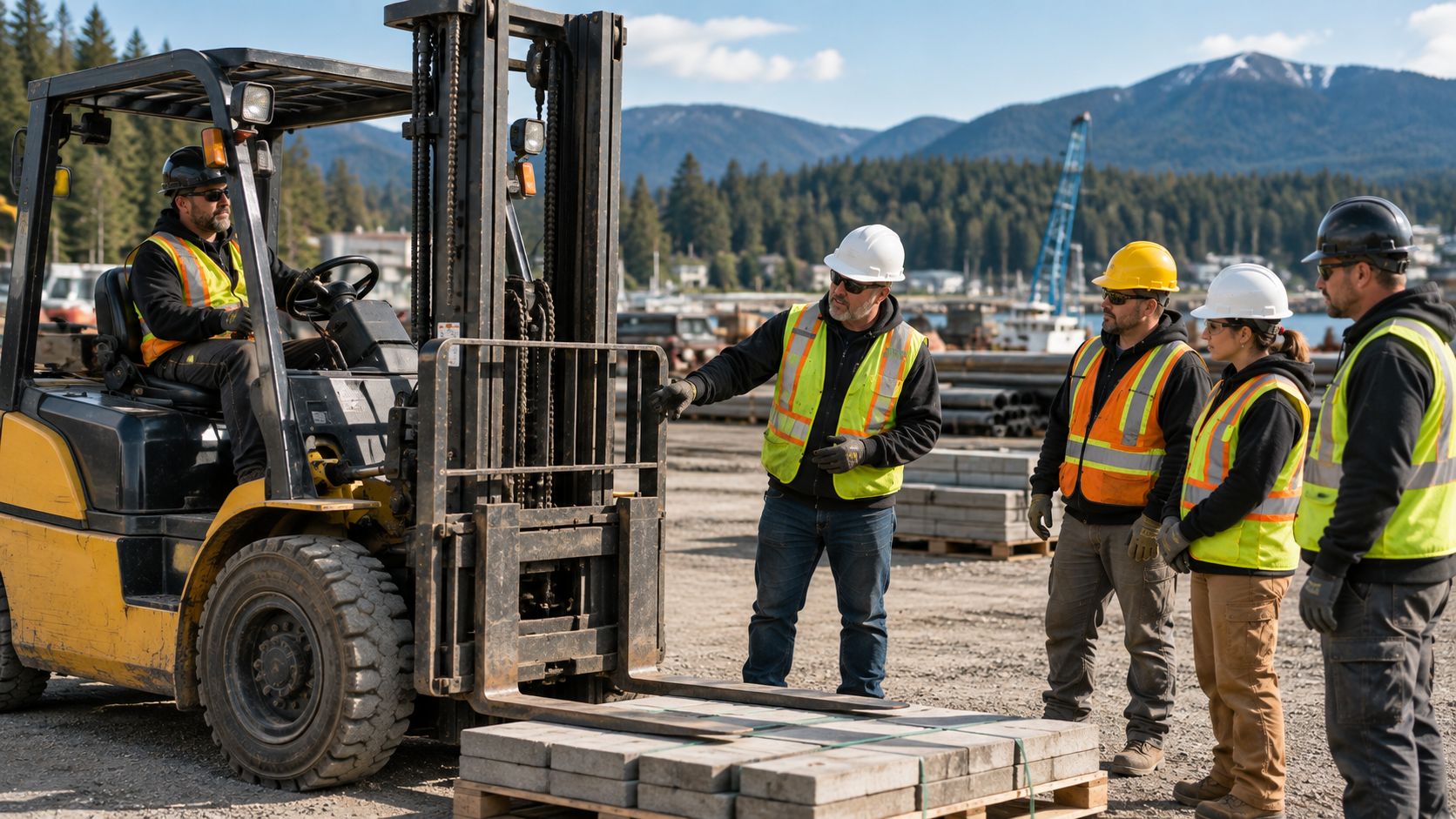
A genuine hands-on evaluation is more involved than many first-time buyers expect. The trainer watches the operator complete a pre-use inspection, mount the machine, and carry out real tasks such as lifting, traveling, stacking, and maneuvering in tight space, correcting habits on the spot before they harden into risk. On a Campbell River site that might mean checking how an operator handles a loaded mast on a sloped mill yard, or how they judge clearance around a busy dock. That observed performance, not the classroom quiz, is what confirms a worker can actually do the job.
The Simple Rule for Who Needs It
The rule is easier than most employers expect. If a worker operates powered mobile equipment as part of their duties, that worker needs to be trained and evaluated on it first. WorkSafeBC places the duty on the employer to ensure operators are instructed, trained, and competent before they run a machine, and for lift trucks the required operator training must meet the CSA standard the regulation references. There is no minimum-hours loophole that exempts someone who only uses a machine now and then.
That last point catches people out. A worker who spends five minutes on a forklift twice a week is still an operator in the eyes of the regulation, and an incident during those five minutes carries the same weight as one during a full shift. Frequency of use does not change the requirement. If the task involves putting a person in control of the equipment, the training and the sign-off need to be in place beforehand, every time.
It also helps to separate two ideas that often get blurred, a licence and a competency sign-off. BC does not issue a single government forklift licence the way it licenses drivers, so what actually qualifies an operator is documented training plus an evaluation showing they are competent on the machine. A wallet card from a quick online quiz is not the same thing, and most Campbell River employers who understand their duty will not treat it as enough. The real credential is the evidence that a qualified person watched the operator work and signed off on it.
The rule also runs the other way for individuals. A worker who wants to be employable across Campbell River worksites benefits from holding current training on the machines local employers actually use. For someone looking for work in warehousing, construction, or forestry support, a documented qualification on a forklift or telehandler is often the difference between being hired on the spot and being turned away because the employer cannot verify competency.
Operator Roles That Almost Always Need It in Campbell River
Some roles run mobile equipment so routinely that the training requirement is rarely in doubt. If your team includes any of the workers below, plan on qualifying them before they operate.
- Warehouse and distribution staff who move product with a counterbalance forklift or a reach truck.
- Construction crews running telehandlers to place material at height on Campbell River job sites.
- Maintenance and facilities workers using scissor lifts or boom lifts to reach ceilings, roofs, or building exteriors.
- Lumber yard and mill support workers handling loads with forklifts or specialized units.
- Retail and grocery receiving staff operating powered pallet jacks on busy floors and around customers.
- Seasonal, temporary, and backup workers who step onto a machine even occasionally during peak periods.
Campbell River’s economy shapes this list in ways a generic checklist would miss. Forestry and mill support work put a lot of forklifts and rough terrain units into yards where footing and load sizes are unforgiving. Marine and waterfront operations around Discovery Passage move gear on equipment in tight, weather-exposed spaces. Warehousing, retail, and municipal crews add scissor lifts, aerial lifts, and pallet jacks to the mix. Each of these settings puts a different worker in a seat, and each of those workers falls under the same basic expectation to be trained on the machine they run.
The practical takeaway is to look at tasks, not job titles. A worker whose title is laborer or groundskeeper may still spend part of the week on a machine, and that time is exactly when a role quietly becomes an operating role. Mapping who touches equipment, rather than who is called an operator, is the fastest way to see who on your Campbell River crew needs training.
The Operators Employers Most Often Overlook
The workers who most often slip through are not the obvious full-time operators. They are the people who use a machine occasionally, informally, or as a favor to keep the day moving, and it is precisely that informality that creates exposure. A qualification gap on an occasional operator is still a gap, and it tends to surface at the worst possible moment.
Supervisors and managers are a common blind spot. A yard lead who hops on a forklift to reposition a pallet, or a site supervisor who runs a telehandler for a few minutes because the regular operator is on break, is operating mobile equipment and needs the same training as anyone else. Seniority does not substitute for a documented evaluation on the machine, and an untrained supervisor sets a poor example for the crew watching them.
New hires with outside experience are another group employers wave through too quickly. Someone who ran forklifts at a previous job may be genuinely skilled, but the employer still carries the duty to verify that competency and to provide familiarization on the specific make, model, and site conditions in use now. A reach truck does not handle like a counterbalance unit, and a mill yard is nothing like the flat warehouse floor a new hire trained on elsewhere. A short evaluation confirms what a resume only claims.
Seasonal and temporary workers round out the overlooked list. When production spikes and extra hands come on to move product or clear a backlog, the pressure to get them working immediately is real. That pressure is exactly when training gets skipped and risk climbs. A backup operator brought in for a busy stretch needs the same sign-off as a permanent one, because the equipment does not behave any differently for a temp.
How Requirements Differ by Machine Type
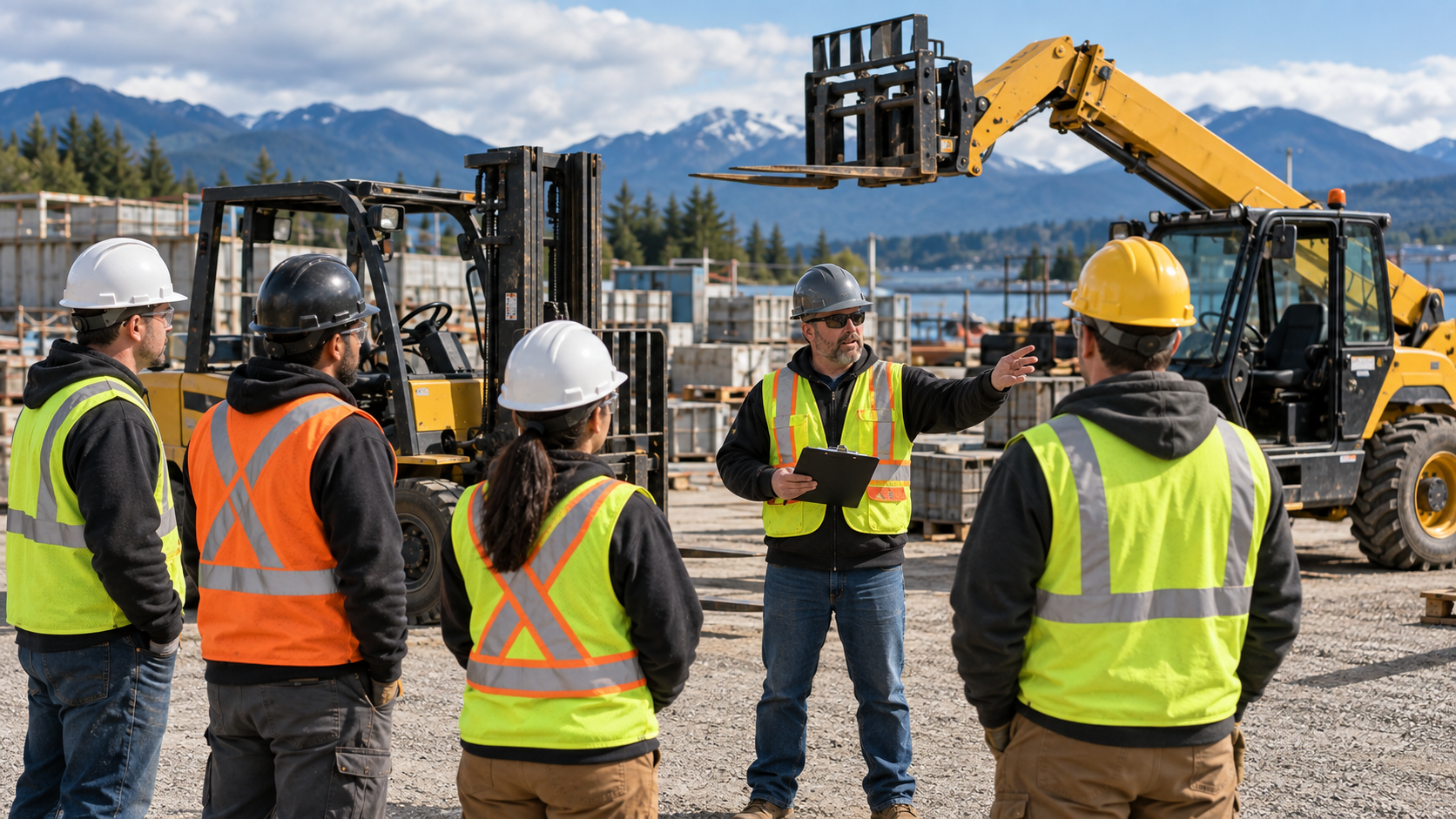
While the general expectation to be trained applies across the board, the details of what training focuses on change with the machine, and so does the operator most likely to be running it. The table below maps common equipment against where Campbell River crews use it and what qualifying on that unit emphasizes.
| Equipment Type | Where Campbell River Crews Run It | What Training Focuses On |
| Counterbalance forklift | Warehouses, lumber yards, distribution and retail backrooms | Load charts, the stability triangle, pedestrian traffic, and stacking |
| Telehandler | Construction sites, framing, and placing material at height | Reach and boom control, load charts at extension, and rough ground |
| Scissor lift | Indoor maintenance, retail fit-outs, and mechanical work at height | Platform positioning, guardrail use, and level ground and tip hazards |
| Aerial or boom lift | Building exteriors, utilities, and sign or tree work | Boom reach, fall protection tie-off, overhead lines, and outriggers |
| Powered pallet jack | Grocery, retail receiving, and warehouse floors | Pedestrian control, load handling, and ramps and dock edges |
A few machine types carry their own specific rules on top of the general expectation. Crane operators, for example, need a separate certificate acceptable to WorkSafeBC rather than the standard operator training that covers a forklift or a lift, so a crane role should never be lumped in with general mobile equipment. Equipment fitted with air brakes brings its own endorsement requirement for the person driving it. These are worth confirming with a trainer whenever a machine falls outside the everyday forklift and lift categories.
Attachments add another layer that employers miss. Fitting a clamp, a rotator, a jib, or a different fork configuration changes how a machine handles and how a load behaves, so an operator checked out on a plain forklift is not automatically ready for the same unit carrying an attachment. When a Campbell River crew adds or swaps an attachment, that change is worth flagging to a trainer, because the operator may need a short familiarization on how the machine performs with it fitted.
Machine-specific familiarization is the thread that ties all of this together. Even a well trained operator moving to a different unit needs time to learn how that particular machine responds, how its controls feel, and how it behaves with a load on the terrain in front of them. Good training treats familiarization as part of the process, not an afterthought, so an operator finishes ready for the exact equipment they will run on your Campbell River site.
What Campbell River Employers Are Responsible For
The responsibility for making sure operators are qualified sits squarely with the employer, and WorkSafeBC frames it that way. The first job is simply knowing who operates equipment. That means walking the operation with fresh eyes and listing every worker who runs a machine, including the occasional and backup users covered earlier, rather than assuming the roster of formal operators tells the whole story.
From there, the employer has to ensure each of those workers is trained, evaluated by a qualified person, and documented. The record matters as much as the training. A clear, dated file showing who was trained on what, and who observed the practical evaluation, is what demonstrates due diligence if an incident is ever reviewed. A printout that only proves someone passed a quiz online does the opposite, because it shows a shortcut where a real assessment belonged.
Keeping a crew current is part of the duty too. Qualifications are not a one-time event that lasts forever. Operators may need a refresher when they move to new equipment, when time has passed, after an incident, or when a specific site requires it, and employers should confirm the current WorkSafeBC and manufacturer guidance rather than assume a fixed interval. Building a simple internal habit of tracking who is due saves a scramble later and keeps operators genuinely ready.
Shared equipment and mixed crews raise a question employers should settle in advance. When a machine is used across multiple sites, or when a subcontractor’s worker operates gear on your site, it is not always obvious who is confirming that person is trained. The better assumption is to verify it yourself rather than trust that someone else did. A quick check of a worker’s training record before they run your equipment protects the operation and closes a gap that shared arrangements tend to open.
Finally, employers in Campbell River gain a lot by having training delivered on their own equipment and at their own site where it makes sense. Onsite delivery means operators learn on the machines and in the traffic patterns they actually work with, which is both more relevant and less disruptive than sending people away to train on a unit they will never see again. It also lets a trainer address the real hazards of that specific yard, whether that is a sloped mill lot, a tight marine staging area, or a busy retail dock.
How Mobile Equipment Training in Campbell River Works With VIF Safety Training
VIF Safety Training is built around the part of the process that actually proves ability, which is the hands-on work. The company is led by Darrell Block, an IVES certified trainer with 24 years of experience driving mobile equipment, so the coaching operators receive comes from someone who has spent a career in the seat rather than only in front of a classroom. That background shapes how operators are evaluated and corrected, and it is the kind of judgment a generic online course cannot offer.
For Campbell River employers, VIF Safety Training focuses on practical, real-world delivery matched to the machines and roles on your crew. Training can be arranged on the equipment operators actually use, with attention to the specific hazards and conditions of the workplace, so a warehouse forklift driver, a construction telehandler operator, and a maintenance worker on a scissor lift each finish genuinely ready for their own task. The approach keeps the knowledge portion efficient and the practical evaluation front and center, which is exactly what real Mobile Equipment Certification Campbell River should mean. The result is a training record an employer can stand behind and operators who can do the job with confidence.
If you are trying to work out which of your operators need training and want a path that holds up in the real world, talk to a trainer before you assign anyone to a machine. VIF Safety Training can help you map who needs qualifying, arrange training on your own equipment, and make sure the hands-on evaluation is handled properly. Call (250) 889-2074 or email info@vanisleforklift.ca to book or ask about training in Campbell River, and you can also contact VIF Safety Training to plan a session around your schedule.
Frequently Asked Questions
- Do you legally need to be certified to operate a forklift in Campbell River?
In practice, yes. WorkSafeBC requires that forklift operators be trained and competent, and lift truck training must meet the CSA standard the regulation references. There is no single government forklift licence in BC, but an untrained operator running a machine puts both the worker and the employer at risk, so proper training and a hands-on evaluation are the real requirement.
- Does a forklift qualification cover a telehandler or a scissor lift too?
No, each class of equipment needs its own training and evaluation. A counterbalance forklift, a telehandler, and a scissor lift handle very differently and carry different hazards, so an operator qualified on one is not automatically qualified on another. Familiarization on the specific machine an operator will run is part of doing it properly.
- Do occasional or backup operators really need training?
Yes, frequency of use does not remove the requirement. A worker who runs a machine for a few minutes now and then is still an operator, and an incident during those minutes carries the same weight as one during a full shift. Occasional and backup operators need the same training and sign-off as full-time ones.
- Is the worker or the employer responsible for making sure operators are trained?
The employer holds the duty under WorkSafeBC. That includes identifying everyone who operates equipment, ensuring each of them is trained and evaluated by a qualified person, and keeping a clear training record. A documented evaluation is what demonstrates due diligence if an incident is ever reviewed.
- We hired someone who ran forklifts elsewhere, do they still need anything?
Usually yes, at least a verification and familiarization step. Prior experience is valuable, but the employer still has to confirm the worker’s competency and introduce them to the specific make, model, and site conditions in use now. A short practical evaluation confirms what a resume only claims, and it protects both sides.
- What kinds of Campbell River workplaces most often need this training?
Construction sites, warehousing and distribution, lumber yards and mill support, marine and waterfront operations, retail and grocery receiving, and municipal crews are the most common. Any of these can put a worker on a forklift, telehandler, scissor lift, aerial lift, or powered pallet jack, and any of those workers needs to be trained on the machine they run.
- Can VIF Safety Training come to our Campbell River site to train operators?
Yes, training can often be arranged onsite so operators learn on your own machines and in your own conditions. Onsite delivery reduces travel and disruption while keeping the training relevant to your workplace. Call VIF Safety Training at (250) 889-2074 or email info@vanisleforklift.ca to plan a session.