Quick Answer: To get aerial lift certified in Nanaimo, an operator completes a course with a qualified provider that covers theory, a written check, a pre-use inspection and a supervised practical evaluation on a boom lift, then leaves with a record of training. British Columbia does not issue a government aerial lift license, so the real test is whether the employer can show the worker is trained and competent on the machine they will run. Before the first job, the employer still walks the operator through that specific machine and the site.
Booking aerial lift operator training in Nanaimo is the first step toward putting a worker in a boom lift basket, but many employers are not sure what the finished result should look like. Some picture a government card, some think a short online video counts, and some assume a scissor lift ticket covers a boom lift as well. None of those is quite right. This guide follows the real path from booking to a qualified operator, one step at a time, so you know what to ask for and what to check.
Everything here is general guidance for Vancouver Island employers and operators, written in plain terms. You will not find invented rule numbers, because the exact wording belongs to the current regulation and to the machine manufacturer. The steady expectation is simple. Operators must be trained and competent on the equipment they use, and the employer is responsible for making sure that is true before anyone leaves the ground. Confirm the current WorkSafeBC requirement for your situation, then use the steps below to plan.
Which Machines Count as Aerial Lifts
An aerial lift, in everyday site language, usually means a boom lift, a machine that raises a worker on a platform at the end of an arm that can reach up and out past the base of the machine. Scissor lifts also raise people to height, but they only travel straight up, and they are normally trained as a separate machine. Knowing which type your crew runs is the first decision in getting operators qualified, because the course and the practical evaluation are built around the machine.
Boom Lifts, Articulating and Telescopic
Boom lifts come in two main styles. A telescopic boom, sometimes called a straight boom, extends in a single line and gives the most horizontal reach, which suits exterior cladding, signage and long reaches across an obstacle. An articulating boom, often called a knuckle boom, has one or more joints that let the platform go up and over an obstruction, such as a run of piping in a plant or a roofline on a tight residential lot. Both styles come as rough terrain diesel machines for outdoor sites and as electric or hybrid units for indoor and noise sensitive work. Towable boom lifts that hitch to a pickup are common with smaller trades and property maintenance crews.
The Canadian standards for these machines, the CSA B354 series, group them by how the platform moves. Scissor lifts sit in Group A, where the platform stays inside the machine’s tipping lines. Boom lifts sit in Group B, where the platform can move out past those lines, which is why stability and positioning take up so much of an aerial lift course. Truck mounted bucket trucks used by utility crews are covered by a different standard and are usually trained on their own.
Where Scissor Lifts Fit
A scissor lift is a related machine but not a substitute for a boom lift, and the reverse is also true. A scissor lift raises the platform straight up over its base, while a boom lift swings, telescopes and reaches, so the hazards, the controls and the setup habits are different. An operator who has only ever run a scissor lift has not yet shown an evaluator they can manage a boom swinging past a wall or a roof edge.
For that reason, most employers treat scissor lift and boom lift qualification as two separate items on the operator’s record, even when both are covered on the same training day. If your crew uses both, tell the trainer up front so the practical evaluation includes each machine. Many employers find it efficient to train both types in one visit, with shared theory and a separate hands-on evaluation for each machine.
How to Book Aerial Lift Training for a Nanaimo Crew
The best way to book aerial lift training is to give the provider a clear picture of your crew, your machines and your site before the date is set. That information shapes the length of the day, the content of the theory and the machine used for the practical evaluation. A short call or email that covers the points below is usually enough to plan boom lift training that fits the way your crew actually works.
- How many operators need training, and whether they are new to boom lifts or experienced but never formally assessed.
- Which machines they will run, including the make, the style of boom and the working height.
- Whether training should happen onsite at your workplace or at a scheduled session elsewhere.
- The hazards on your site, such as overhead power lines, sloped or soft ground, traffic and tight access.
- The dates and shifts that cause the least disruption to production.
On the day itself, the trainer will need the boom lift fuelled or charged and already checked over, a clear area with room to travel, turn and reach toward a target, and a quiet space with a table for the theory portion. Having the operator manual for each machine on hand saves time, because operators learn to find the load, wind and slope limits in the real document for the real machine rather than in a generic handout.
Planning ahead also gives you time to think about budget, and the factors that drive the price of a boom lift course are much the same across the Island. Our post on what aerial lift certification costs in Campbell River walks through those factors in detail. For a Nanaimo crew, onsite training often makes the most sense when you already own or rent the boom lift, because operators are evaluated on the exact machine and ground they use every day, whether that is a yard in the Duke Point industrial area or a sloped commercial lot in one of the city’s hillside neighbourhoods.
What the Aerial Lift Course Covers From Theory to Practical
A complete aerial lift course covers two halves that depend on each other, the knowledge behind correct boom lift operation and the hands-on skill to apply it on a real machine. A course that leaves out either half produces an operator who can pass a quiz but hesitates in the basket, or one who can drive the machine without understanding why a setup is wrong. The two parts below make up a proper course.
Theory and the Written Check
The theory portion builds the picture an operator carries to every job. It typically covers how a boom lift stays stable and what threatens that stability, how to read the capacity plate, which counts the combined weight of people, tools and materials, and how slope, soft ground and wind affect the machine. The manufacturer’s manual sets the wind and slope limits for each model, and a good course teaches operators to find those limits rather than guess at them.
Hazard recognition takes up a large share of the theory. Operators learn to spot overhead power lines and keep the boom well clear of them, to watch for crushing points where the platform could pin a worker against a beam or a ceiling, and to plan around traffic and pedestrians below. They also learn how the ground controls and emergency lowering work, so a co-worker on the ground can bring the platform down if the operator cannot. The theory ends with a written check that confirms the material landed, which gives the employer evidence of the knowledge rather than an assumption based on attendance.
Pre-Use Inspection and the Practical Evaluation
The hands-on part starts before the machine moves, with a pre-use inspection. The operator walks around the boom lift checking tires, hydraulic hoses and fittings for leaks, the pins and welds on the boom, the platform floor, gate and guardrails, the anchor points, the decals and the capacity plate, and confirms the manual is in its storage box. Function tests from the ground controls come next, including the emergency stop and the emergency lowering system, followed by a look at the work area for slopes, holes, soft ground and overhead hazards. A rushed walkaround is one of the most common habits a trainer corrects, because it is where small faults get caught before they become big ones.
The practical evaluation then has the operator run the boom lift through a full routine while the evaluator watches. That routine usually includes travelling with the platform stowed, positioning the machine in the work area, raising and extending the boom toward a target, working near a structure without contact, and lowering and parking the machine correctly. The evaluator also watches how the operator uses the enable control that most boom lifts require before the platform will move, how they check behind and below before swinging, and how they work with a spotter in tight spaces. The evaluator is looking for smooth, deliberate control and good judgment, not speed. If an operator needs more time, a good trainer coaches the weak spots and reassesses rather than signing off someone who is not ready. That supervised evaluation is why real aerial lift certification cannot be finished entirely online.
The table below shows how each stage fits together on the way to a qualified operator. Exact content and timing vary by provider, by machine and by the operators in the group, so treat it as a planning guide rather than a fixed promise.
| Stage | What the Operator Does | What It Shows the Employer |
| Theory | Learns stability, capacity, wind and slope limits, power line and crushing hazards, and emergency lowering | The operator understands why each step matters |
| Written check | Completes a short assessment on the theory | The knowledge landed, not just attendance |
| Pre-use inspection | Walks around the machine, tests the ground controls and checks the work area | The operator catches faults before leaving the ground |
| Practical evaluation | Runs the boom lift through a full routine with an evaluator watching | The operator can run the machine competently |
| Familiarization at your site | Learns the specific machine, the site rules and the rescue plan from the employer | The operator is ready for this machine on this job |
Fall Protection While Working From a Boom Lift
An operator working from a boom lift wears a full body harness connected by a lanyard to the anchor point the manufacturer provides in the platform. The WorkSafeBC regulation on ladders, scaffolds and temporary work platforms expects a person on this kind of work platform to wear a personal fall arrest system, with a narrow exception for scissor lifts on firm, level ground with guardrails in place. Confirm the current requirement for your situation, since regulations are updated from time to time.
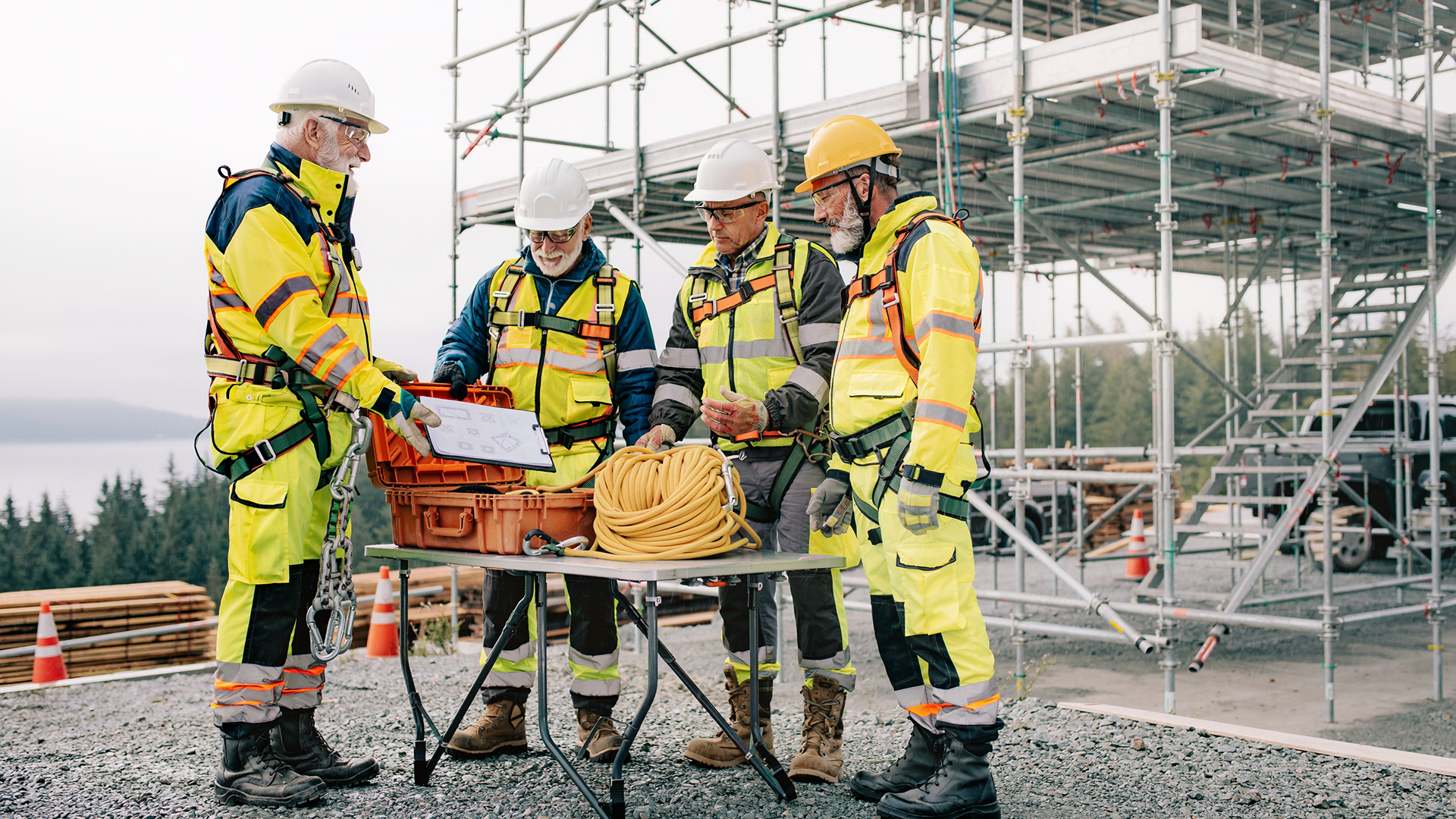
Aerial lift training covers the harness side of the job because a boom changes how a fall happens. A worker can be thrown from the basket if the machine is struck, if a wheel drops into a hole, or if the boom snags on something and springs free, so the harness and lanyard stay on the whole time the platform is up. The course covers how a harness should fit, how to check the harness and lanyard before use for cut or burned webbing, broken stitching, damaged buckles and a missing or faded label, why the lanyard connects to the platform anchor and never to a nearby beam or structure, and why operators keep both feet on the platform floor instead of climbing the guardrails. Trainers also explain that a harness or lanyard that has stopped a fall is taken out of service, even when it looks fine.
Rescue is the other half of fall protection at height. If the machine stalls in the air or a worker is left hanging in a harness, someone on the ground needs to know how to use the ground controls or emergency lowering to bring the platform down quickly, and the employer should have that plan in place before work starts. Workers who also wear harnesses away from the lift, on roofs or near open edges, need broader fall protection training, and our sibling post on how long fall protection training takes in Nanaimo explains how that course is planned and when to retrain.
What You Leave With and What the Employer Still Has to Do
An operator who completes the course and passes the practical evaluation leaves with a record of training, sometimes with a wallet card, that shows the operator’s name, the date, the type of machine assessed and the trainer. The employer keeps a copy on file, and the operator can show it when a general contractor or site owner asks for proof at the gate. That record is the visible result of aerial lift certification, but it describes training on a type of machine, not on every machine your company owns or rents. When you review a record, check that the machine category is written clearly enough to match against your fleet, for example a self-propelled articulating boom rather than a vague line that only says aerial lift.
The employer’s job is not finished when the trainer leaves. Before an operator runs a specific boom lift on a specific job, the employer familiarizes that operator with the machine and the site. Familiarization covers where the controls and emergency lowering are on that make and model, any features the training machine did not have, the site rules, the ground and overhead hazards, the traffic plan and the rescue plan. The employer then decides the operator is ready to use that machine, and a supervisor watches the first few jobs closely.
Training is not permanent. Skills fade without regular use, machines get replaced, and sites change from one project phase to the next. A move to a different style of boom, a new site with very different ground, or a near miss are all reasons to reassess an operator sooner, and the refresher cycle itself should be checked against the current requirement and your own training program.
How VIF Safety Training Delivers Aerial Lift Operator Training in Nanaimo
VIF Safety Training helps Nanaimo employers get boom lift operators qualified without pulling a crew off the job for longer than needed. Owner and lead instructor Darrell Block is an IVES certified trainer with 24 years of experience operating mobile equipment, so the coaching in the basket comes from someone who has done the work as well as taught it.
Training can be delivered onsite at your worksite, which means operators are assessed on the boom lift they actually use, on the ground they actually work on, whether that is a construction site, an industrial yard or a commercial building. The practical evaluation focuses on the habits that matter most, a thorough walkaround, careful positioning, smooth control near structures and correct use of the harness, and it is never rushed to save an hour. Because timing and content vary by machine and by operator, the best first step is a short conversation about your crew, so aerial lift operator training in Nanaimo matches the real work rather than a generic script.
If you need one operator qualified on a boom lift or a whole crew trained on several machines, VIF Safety Training can plan it around your schedule. Call (250) 889-2074 or email info@vanisleforklift.ca to talk through your machines, your people and your timing, or contact VIF Safety Training to book aerial lift training in Nanaimo at your worksite.